

NaDiRa Monitoring Report
The monitoring report examines three key questions:
- How widespread are racist attitudes in Germany?
- What subtle and overt experiences of discrimination do people encounter in their daily lives?
- And how does indirect exposure to racism manifest itself?
And what are the consequences for trust in state institutions and social cohesion?
The 2026 Monitoring Report provides nuanced answers based on current data from the NaDiRa.panel. It highlights the interplay between overt and covert racist attitudes, as well as the prevalence of direct and indirect experiences of racism. The report reveals who is particularly affected and what consequences these have for trust and social
cohesion. It is primarily based on the sixth wave of the NaDiRa.panel survey, which was conducted between October 2025 and January 2026 with 8,171 participants (5th/6th wave). The data is derived from a representative online survey of adults aged 18 to 74 living in Germany.

Racist attitudes and experiences of discrimination are key factors in understanding inequalities, their development, and their consequences in society. When collecting and analyzing data, it is essential that the methods used take different perspectives into account. The interplay between overt and subtle forms of racist attitudes, as well as direct and indirect experiences of racism, provides a nuanced overall picture.
The study
The Monitoring Report of the National Discrimination and Racism Monitor is published annually in March to coincide with International Week Against Racism. It is based on a representative, recurring online survey of adults aged 18 to 74 living in Germany. In addition to racist attitudes and experiences of discrimination, the report also captures indirect exposure to racism as well as societal consequences, particularly regarding trust in state institutions.
This year’s report is based on the sixth survey wave of the NaDiRa.panel, which was conducted between October 2025 and January 2026. The data is based on a representative online survey of adults aged 20–74 living in Germany. To illustrate trends over time, the first survey wave from 2022 and the fifth survey wave from 2024/2025 are also included.
The report thus joins a series of earlier NaDiRa publications: The inaugural study *Racist Realities* (DeZIM 2022) was the first to systematically demonstrate how widespread racist discrimination is in Germany and how strongly racist knowledge, perceptions, and evaluations shape everyday social life. The 2025 Monitoring Report Hidden Patterns, Visible Consequences (Fuchs et al. 2025) continued this systematic observation of societal developments.
The latest monitoring report shows that experiences of discrimination and trust in institutions are closely linked and remain distributed very differently across population groups. Five years after our initial study, “Racist Realities,” issues of migration, belonging, and racism remain at the center of social debates—in some cases, even in an intensified form. Against this backdrop, continuous, empirically grounded monitoring is particularly important. It creates a robust foundation for contextualizing social developments and grounding policy in reliable data.
At a glance
The report compiles current findings on racist attitudes, experiences of subtle and overt discrimination, indirect exposure to racism, and the institutional consequences of racism in Germany. Key findings
include:
- 36% agree with the statement that there are different human “races.”
- 48% believe that certain groups are “naturally more hardworking” than others.
- 66% believe that certain cultures are “more progressive and better” than others.
- 25% of Black respondents and 17% of Muslim respondents report being openly discriminated against at least once a month.
- 30% have heard about experiences of racism from their social circle in the past twelve months, and 28% have personally witnessed racist incidents.
- Among people who are racially targeted and frequently experience discrimination, trust in the federal government drops from 48% to 29%; trust in the police drops from 90% to 65%.
What does “racially marked” mean?
The report uses the term “racially marked” as an analytical tool to make statistically visible groups that may be affected by racist attributions in Germany. The report includes Black, Asian, Muslim, and Eastern European people in this category. People who identify exclusively as German without a migration background, as white, or as both are considered “not racially marked.”
Detailed results (selection)
The 2026 Monitoring Report examines racism and discrimination in four interconnected areas: racist attitudes, experiences of subtle and overt discrimination, indirect exposure to racism, and societal consequences. The following figures show how widespread racist patterns of interpretation are, how unevenly experiences of discrimination remain distributed across population groups, and how closely these experiences are linked to trust in state institutions.
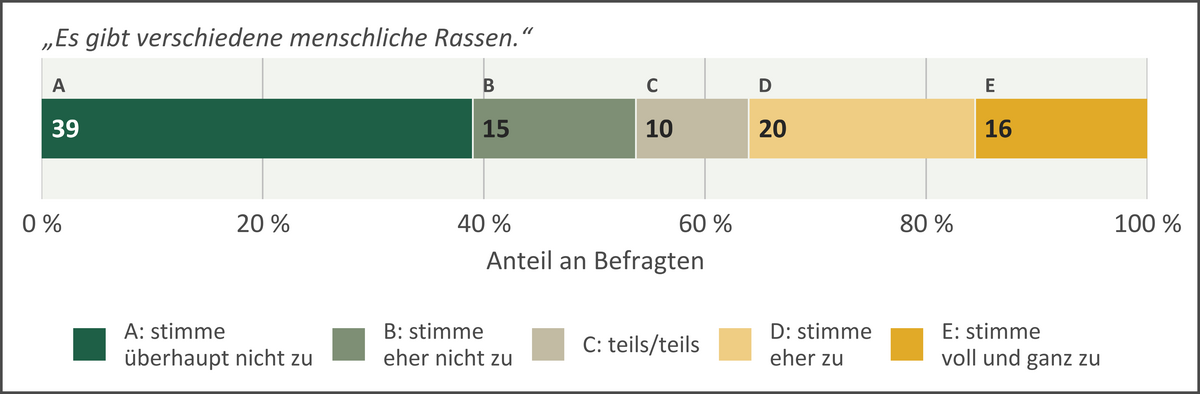
Biological assumptions about supposedly natural differences between people remain widespread. 36% of respondents agree with the statement that there are different human “races.” Differences emerge between individual groups: for example, depending on whether respondents have a higher formal education level or a middle or lower one: 61% of those with a high level of formal education “(tend to) disagree”—compared to 42% among those with a low level of formal education. Higher education thus appears to be associated with a greater rejection of biological notions of “race,” without, however, fundamentally dispelling them. The report thus makes it clear that biological notions of “race” remain entrenched in a significant portion of the population despite their scientific refutation.

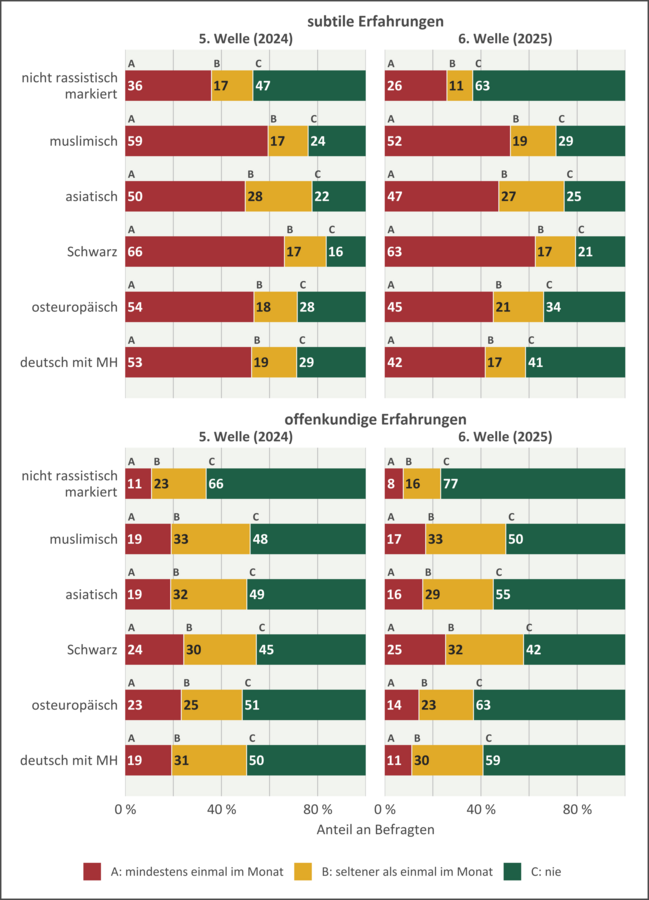
Experiences of discrimination in everyday life remain widespread, even though their prevalence among the general population is declining. However, this decline is not uniform: while the proportion of people not identified as racial minorities who have not experienced discrimination is increasing significantly, people identified as racial minorities continue to report everyday discrimination particularly frequently. Overall, 73% of racially marked individuals report having experienced discrimination in the past twelve months. The differences are particularly pronounced in public spaces: around 26% of Muslim men and 35% of Muslim women report experiences of discrimination there; among Black respondents, the figures exceed 40% for both men and women. Among people not identified as belonging to a racial minority, the figures are significantly lower, at 7% for men and 11% for women. In interactions with government offices and agencies as well, Muslim and Black respondents in particular report experiences of discrimination comparatively frequently, with rates of around 28% to 33%, while the rates for people not identified as belonging to a racial minority are in the single digits.
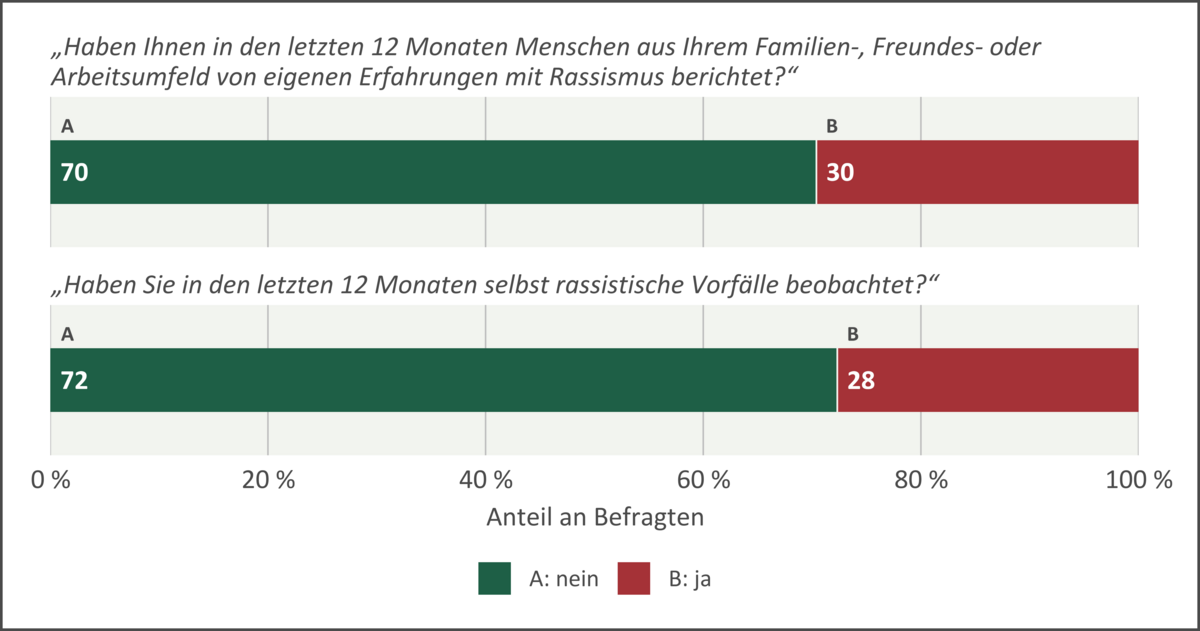
Racial discrimination does not only affect people directly. It also has an indirect impact when racist incidents are witnessed or relayed through one’s social circle. This is precisely what Figure 12 shows: Nearly one in three people (30%) report that they have been told about experiences of racism within their family, circle of friends, or work context in the past twelve months; 28% have personally witnessed racist incidents during the same period. The report describes this indirect impact as a shared experience that extends beyond those directly affected.
Young people in particular encounter such experiences more frequently. In the 25- to 34-year-old age group, 42% report hearing accounts of experiences of racism and 46% report having personally observed racist incidents. Among 45- to 54-year-olds, the figures are 28% and 26%, respectively.
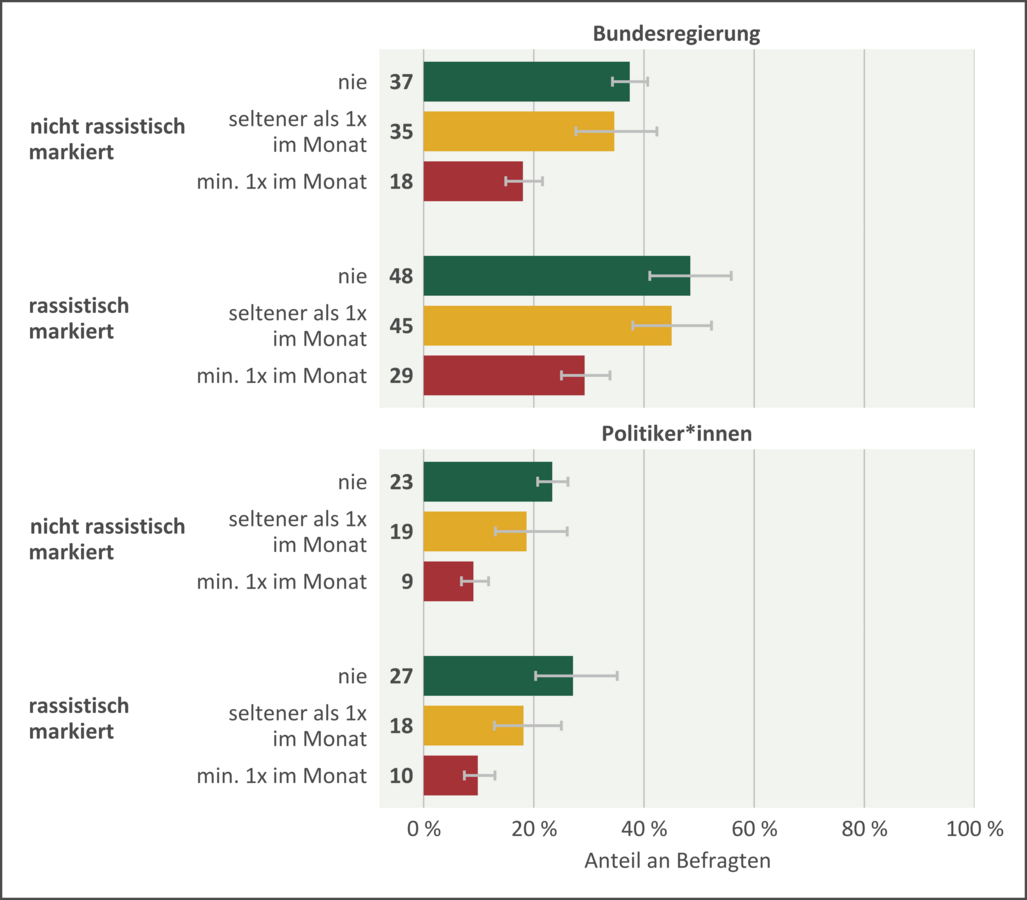
Frequent experiences of discrimination are associated with lower levels of trust in government institutions. This link is particularly evident when it comes to representative institutions such as the federal government and politicians. In both groups, trust declines as the frequency of experiences of discrimination increases; this link is especially strong among people who are perceived as racialized. The report suggests that discrimination is not only experienced as an individual burden but is also processed as a politically relevant experience—for example, in terms of disappointed expectations regarding state protection, equal treatment, or political representation.
When looking at individual groups, clear differences emerge: Among racially marked respondents who have not experienced discrimination in the past twelve months, 48% trust the federal government; among those experiencing discrimination at least once a month, the figure is 29%. A similarly graded relationship is evident regarding trust in the police: among racially marked individuals, the proportion without experiences of discrimination is 90%, at 82% for those experiencing discrimination rarely, and at 65%for those experiencing discrimination at least once a month. The report points out that institutional mistrust becomes particularly entrenched when discrimination is experienced repeatedly and regularly
How racism and discrimination are addressed in the report
The monitoring report defines racism not only as overt denigration, but also as unequal treatment that has a societal impact. For this reason, NaDiRa captures both racist attitudes and experiences of discrimination, as well as their consequences. Discrimination is not measured in abstract terms, but through concrete everyday experiences: Respondents were asked how often certain situations had occurred to them in the past twelve months, such as being treated unkindly, not taken seriously, stared at, insulted, threatened, harassed, physically attacked, or ignored.
These experiences are only counted as instances of discrimination if the respondents themselves associate them with a specific characteristic, such as skin color, religion, name, perceived origin, non-German citizenship, or language skills. The report distinguishes between subtle and overt forms of discrimination; subtle experiences such as being ignored or not taken seriously are significantly more widespread than overt insults, threats, or attacks. Additionally, the report also captures indirect exposure to racism—that is, experiences conveyed through reports from one’s social circle or through the observation of racist incidents.
For the analysis, the report also relies on self-identification. Respondents classify themselves into specific groups. On this basis, an analytical distinction is made between “racially marked” and “non-racially marked” individuals to reveal how people in Germany are categorized as racialized or how they position themselves in this context. Individuals who identify exclusively as German without a migration background, as white, or as both are considered non-racially marked. This classification is explicitly intended as an analytical tool: it complements conventional categories such as migration background but can only reflect societal attributions to a limited extent.
Data source
The 2026 Monitoring Report is based on the NaDiRa.panel, a representative online longitudinal survey of the population living in Germany aged 18 to 74 that has been ongoing since 2022. The study is based on a random sample drawn from the resident registration offices of German municipalities and makes it possible to track developments over several years. For the current report, data from the sixth survey wave, covering the period from October 2025 to January 2026, were primarily analyzed; data from the 2022 and 2024/2025 waves were also used to supplement the analysis.
A distinctive feature of the NaDiRa.panel is the deliberate overrepresentation of population groups that are potentially affected by racism in Germany. This allows their experiences to be analyzed more precisely than is possible in many traditional population surveys.
Sample size
- 2022 wave: 21,394 respondents
- 2024/2025 wave: 9,509 respondents
- Wave 2025/2026: 8,171 respondents
Why are certain groups overrepresented?
Certain groups in Germany that are potentially affected by racism often appear only in small numbers in traditional population surveys. The NaDiRa.panel has therefore intentionally included them more heavily in the sample so that their experiences can be analyzed more accurately. To ensure the results remain representative of the general population, the data is weighted in multiple stages and, for the 2026 Monitoring Report, additionally adjusted to the 2022 Microcensus.
Recommendations for Action
- Strengthen anti-racist
education Biological, culturalist, and modern forms of racist attitudes should be addressed more thoroughly in educational, training, and continuing education programs. The report recommends systematically integrating the examination of racist knowledge into these programs. - Improving protection
against discrimination Especially in areas with pronounced power imbalances—such as in administration, the police, and the judiciary—structures and procedures should be reviewed to determine whether they facilitate or reinforce discrimination. This also includes better complaint channels and more effective enforcement of the law. - Expand independent monitoring and
complaint structures The report emphasizes that those affected need low-threshold and reliable avenues to report discrimination and have it investigated. Independent bodies can help strengthen institutional responsibility and accountability. - Give greater consideration to
indirect experiences of discrimination Racism affects people not only through their own experiences but also through observed incidents and reports from their social environment. These forms of indirect experience should be given greater consideration in prevention, counseling, and institutional contexts. - Targeted efforts to strengthen trust in
state institutions Since experiences of discrimination are closely linked to lower trust in institutions, the report recommends transparent procedures, clear responses to incidents of discrimination, and greater representation of people targeted by racism in public institutions. - Ensuring long-term
monitoring and research Continuous data collection, nuanced analyses, and the involvement of affected communities are necessary to make developments visible and to ground policy measures in a robust empirical foundation.